What is The Shared Rhythms Framework™ ?

The Shared Rhythms Framework is a developmental ecology framework for restoring the everyday experiences that young nervous systems are built to expect.
It is rooted in a simple idea:
Children have young bodies, but ancient nervous systems.
Their brains and bodies are designed to develop through repeated access to core human experiences: movement, outdoor time, predictable daily rhythms, co-regulation, shared attention, meaningful participation, and everyday life with other people.
But children do not develop in isolation.
They develop within a living system: their caregivers, their home, their routines, their community, and the adults who support them.
Modern family life has changed rapidly. Many children now spend less time moving, less time outdoors, less time participating in everyday tasks, and more time in passive or adult-managed environments. At the same time, many caregivers are carrying extraordinary demands, making these developmental rhythms harder to access, establish, and sustain.
The Shared Rhythms Framework helps providers understand this entire developmental ecology — not just the child, but the system around the child.
Rather than focusing only on strategies, it helps practitioners notice what may be missing, thin, or difficult to sustain within a child’s daily life, and then work with families to restore those developmental inputs through small, realistic, relationship-based routines.
It also recognizes that the provider’s nervous system matters.
Children are influenced not only by what adults do, but by how adults show up. The emotional state, capacity, and presence of both caregivers and providers shape learning, coaching, and connection.
It is not about blaming families.
It is about recognizing that children are developing inside a rapidly changing world — and that some children, especially those with more sensitive or neurodivergent nervous systems, may need more intentional, repeated, relational, and embodied support to access the experiences their development depends on.
The Mission
My mission is to bring awareness to what I believe is a growing early childhood public health concern.
Modern life has changed the daily routines and experiences through which young nervous systems develop. Many children appear to be receiving less of what their bodies and brains are built to expect: movement, outdoor time, predictable rhythm, co-regulation, engagement with people, and participation in shared daily life.
At the same time, children who come into the world with more sensitive, intense, or neurodivergent nervous systems may need more support, more repetition, and more intentional access to these experiences — not less.
When those needs are not met consistently, the result may be increased stress, dysregulation, family strain, developmental vulnerability, and greater functional difficulty. It may also contribute to the increased visibility, referral, and diagnosis of neurodevelopmental differences such as autism and ADHD.
The goal of this work is not to prevent neurological difference.
The goal is to reduce preventable stress, support function, and improve quality of life for neurodivergent children and their families.
With better awareness, early intervention can become more precise, more relational, and more grounded in the daily experiences children need most — especially during the sensitive early years.
This work also points beyond individual families. If modern childhood has changed, then our systems must change too. Families need better support. Childcare providers need better training. Neurodivergent children need environments that understand their nervous systems. And policy must begin to reflect what early development actually requires.
Core Values
Authenticity
This work is grounded in real clinical experience, honest reflection, and a commitment to naming what many providers and families are already seeing.
Science-Based Thinking
The framework draws from developmental science, nervous system development, early childhood learning, anthropology, and early intervention practice. It will continue to evolve as the evidence evolves.
Transparency
This is an emerging framework. I will be clear about what is research-supported, what is clinical observation, what is theory, and what still needs to be studied.
Neuro-Affirming Practice
The goal is not to make neurodivergent children appear neurotypical. The goal is to better understand what their nervous systems need in order to feel safe, connected, regulated, supported, and able to participate in daily life.
Family Respect
Families are not failing. They are raising children inside a world that often makes basic developmental rhythms harder to access. This framework is designed to reduce shame and increase clarity.
Systems Awareness
A child is never developing in isolation. The child, caregiver, provider, home environment, childcare setting, and broader culture all matter.
How this applies to early intervention
While The Shared Rhythms Framework is an overall childhood framework, early intervention is one place we can begin using it right away.
For EI providers, especially SLPs, the framework offers a clearer way to make sense of hard-to-structure sessions — particularly when a child is difficult to engage, family routines are limited, or the caregiver is overwhelmed.
Instead of relying only on isolated strategies, the provider asks:
What daily rhythm can we join or build?
What does this child’s nervous system need first?
Does this child need movement, regulation, outdoor time, shared doing, or a more predictable routine in order to become available for communication and learning?
What small step could the caregiver realistically repeat between visits?
The framework also considers the whole system in the room: the child’s nervous system, the caregiver’s regulation needs, the provider’s capacity, the family’s daily reality, and the broader cultural context shaping modern childhood.
A free introduction to The Shared Rhythms Framework is coming soon.
The Starter Guide and free intro course will give providers the first layer of the framework: the core concepts, the MODES lens, and a simple way to begin applying it in early intervention sessions.
More in-depth training and implementation tools will be released over time.
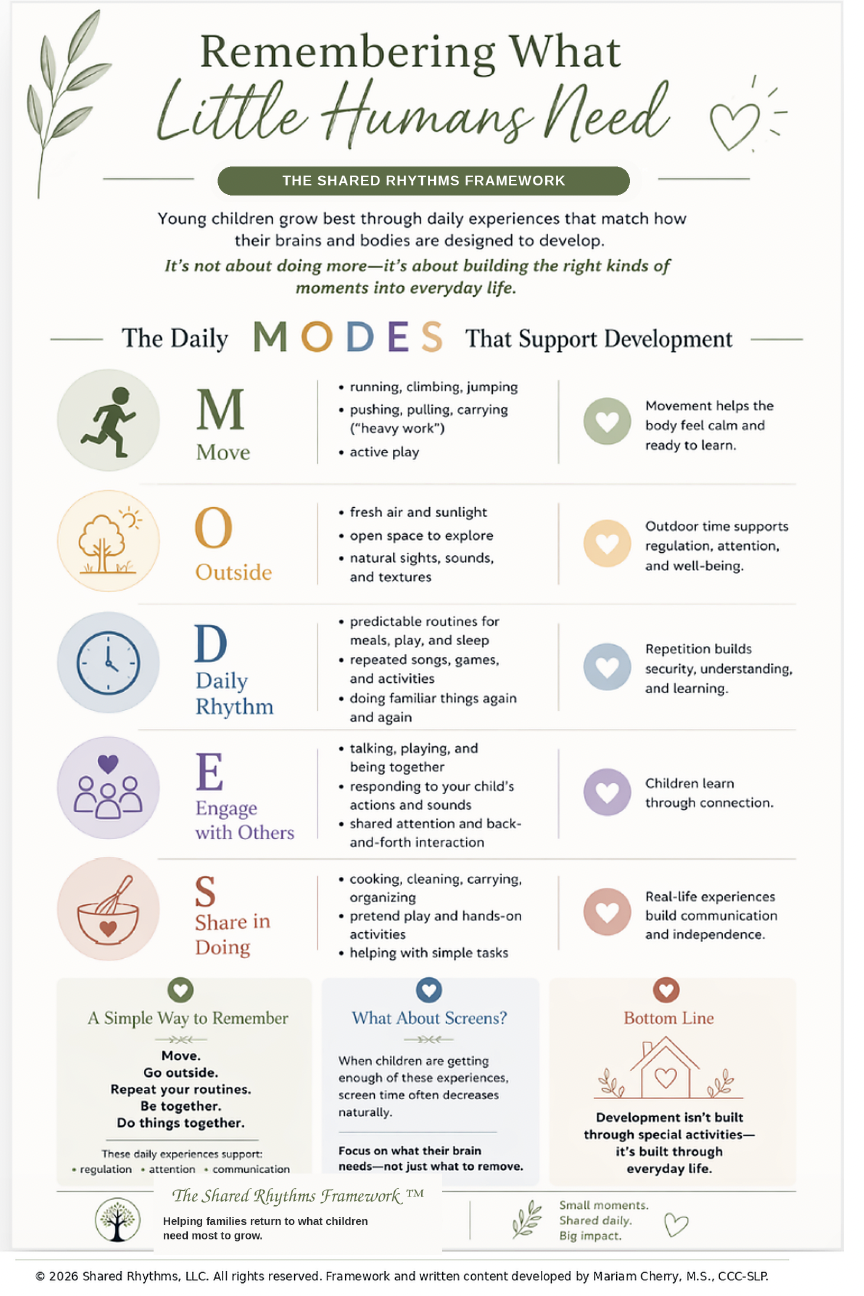
MODES: Five Everyday Pathways for Developmental Input
MODES organizes five everyday pathways that support regulation, attention, communication, sensory organization, participation, and well-being:
M: Movement
Examples: climbing • crawling • carrying • pushing • pulling • lifting • dancing • balancing • jumping • running • heavy work
Why it matters: supports body awareness, regulation, motor planning, attention, confidence, and sensory organization.
O: Outdoor Time
Examples: light • air • weather • open space • uneven ground • digging • splashing • climbing • collecting • exploring
Why it matters: offers rich sensory and motor experiences that are hard to replicate indoors, helping children organize their bodies, attention, and regulation.
D: Daily Rhythm
Examples: sleep • rest • meals • snacks • transitions • repetition • recovery • separation • reconnection • familiar routines • rhythmic music
Why it matters: supports security, regulation, attention, learning, emotional stability, and the body’s basic rhythms.
E: Engagement with Others
Examples: co-regulation • shared attention • imitation • language • singing • gesture • emotional attunement • repair • touch • shared caregiving • seeking more community
Why it matters: builds connection, language, belonging, trust, and a wider web of relational support.
S: Shared Doing
Examples: helping • choosing • waiting • trying again • cooking • cleaning • carrying • sorting • dressing • feeding pets • playing • participating • singing
Why it matters: supports fine motor development, imitation, problem-solving, communication, language, and autonomy through real-life participation.
Free Resource
This guide is an example of how the Shared Rhythms Framework can be translated into simple language.
It helps providers and families notice everyday opportunities for movement, outdoor time, rhythm, connection, and shared participation — without adding pressure or blame.
A Broader Developmental Ecology
MODES is not meant to capture every developmental need in isolation. It is a simple doorway into a broader developmental ecology.
In infancy and toddlerhood, the developing nervous system depends on repeated access to regulation, movement, sensory-rich exploration, responsive caregiving, language, sleep, nourishment, predictable rhythms, emotional safety, repair, safe challenge, social connection, autonomy, and meaningful participation.
MODES helps families and systems restore many of these inputs through ordinary daily life.
Why Restoration Matters
The theory behind this framework is the Trait Visibility Amplification Model, or TVAM.
TVAM explores whether reduced access to repeated, experience-expectant developmental inputs may interact with a child’s underlying neurobiological vulnerabilities during sensitive periods of early development.
In this view, modern developmental conditions do not create neurodevelopmental traits from nothing, and neurodivergence is not treated as something to eliminate.
Instead, TVAM asks whether reduced access to movement, co-regulation, shared attention, outdoor time, daily rhythm, and meaningful participation may interact with a child’s underlying vulnerabilities and function as a neurobiological amplification mechanism — potentially increasing avoidable distress, dysregulation, trait visibility, and functional support needs in some children.
The Shared Rhythms Framework is the restorative response.
It asks how families, providers, childcare settings, communities, and public health systems can restore more of the developmental conditions young children are built to rely on as they grow.